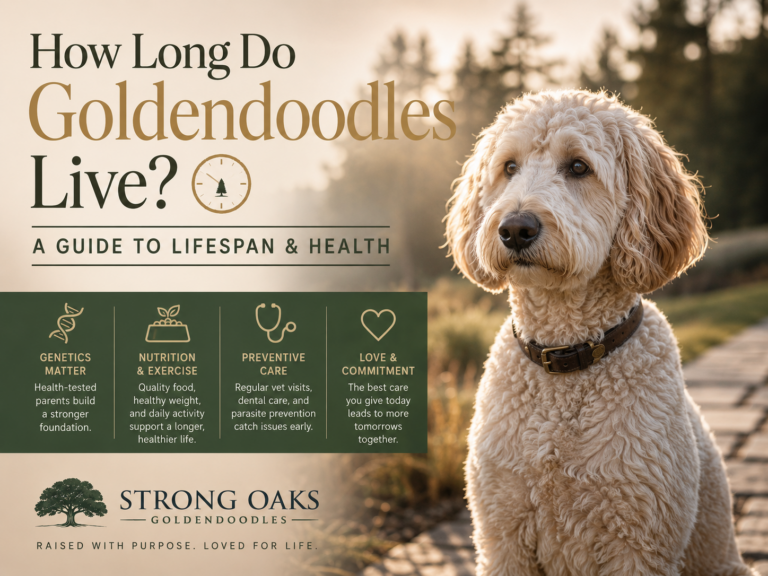
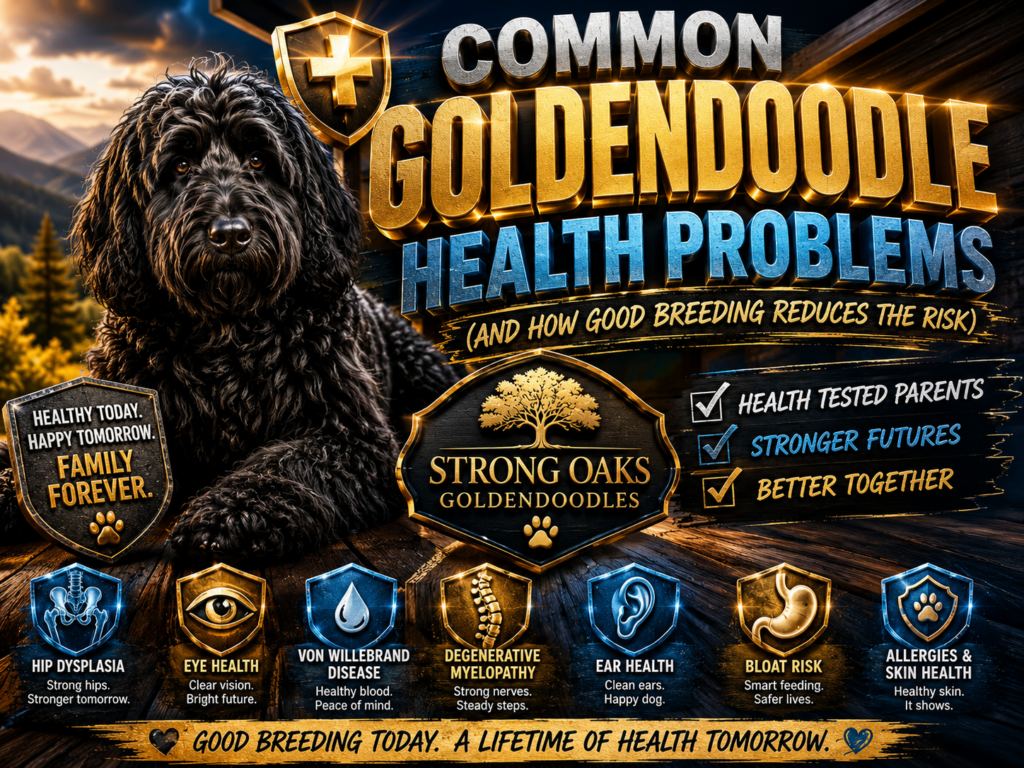
When families research a breed before bringing a puppy home, health is one of the first things on their minds — and it should be. The good news is that Goldendoodles are generally a healthy, long-lived breed, helped along by what’s often called hybrid vigor: the genetic advantage that comes from crossing two different purebred lines.
But “generally healthy” doesn’t mean “immune to everything.” Goldendoodles inherit their genes from Golden Retrievers and Standard Poodles, and both breeds carry a handful of conditions worth understanding. Here’s an honest look at the health issues that can affect Goldendoodles, and — just as importantly — how responsible breeding dramatically lowers the odds of ever seeing them.
First, the Reassuring Part
Goldendoodles typically live 10 to 15 years, and the majority live full, healthy lives. Most of the serious conditions we’ll cover below are inherited, which means they can be screened for before a litter is ever bred. That’s the single most powerful tool a breeder has, and it’s why the questions you ask a breeder about health testing matter so much. If you’d like a deeper look at typical lifespan and what shapes it, our post on how long Goldendoodles live covers that ground.
Hip Dysplasia
Hip dysplasia is one of the better-known concerns in larger breeds, including Standard Goldendoodles. It’s a malformation of the hip joint that can lead to arthritis, stiffness, and discomfort as a dog ages. Genetics play a significant role, though weight and activity matter too.
Keeping your Goldendoodle at a healthy weight and avoiding hard, repetitive impact during the fast-growing puppy months goes a long way. Our guide on how much exercise a Goldendoodle needs breaks down age-appropriate activity so you’re building healthy joints, not stressing developing ones.
Eye Conditions (Progressive Retinal Atrophy)
Progressive Retinal Atrophy, or PRA, is an inherited condition found in both parent breeds. It causes the light-sensing cells in the retina to gradually break down, leading to declining vision and, in many cases, eventual blindness — usually developing in adulthood rather than puppyhood.
PRA is exactly the kind of condition that thoughtful, health-tested breeding is designed to prevent. Because it’s inherited in a predictable pattern, screening parent dogs before breeding is the key to keeping it out of a line.
Von Willebrand Disease
Von Willebrand Disease is an inherited bleeding disorder that affects normal blood clotting, and it’s seen in Poodles and therefore in Goldendoodles. Affected dogs may bruise easily or bleed longer than normal after an injury or surgery. Like PRA, it’s inherited in a way that makes it screenable before breeding — which is precisely why we test.
Degenerative Myelopathy
Degenerative Myelopathy (DM) is a progressive neurological condition affecting the spinal cord, usually appearing in a dog’s senior years and causing gradual hind-limb weakness. It’s found in both parent breeds. Again, it’s an inherited condition that responsible screening can account for before a pairing is ever made.
Ear Infections
This one isn’t genetic — it’s structural. Goldendoodles have floppy ears and hair that grows in the ear canal, which traps moisture and creates a warm environment where infections can develop. It’s one of the most common everyday health issues Goldendoodle owners deal with, and it’s very manageable with routine care.
Regular ear cleaning and keeping the ears dry after baths and swimming makes a real difference. We cover ear care as part of our grooming guide, and the gentle ear cleaner and drying powder we actually use on our own dogs are both on our recommended products page.
Bloat (Gastric Dilatation-Volvulus)
Bloat is a serious, sometimes life-threatening condition in deep-chested dogs, including larger Goldendoodles, where the stomach fills with gas and can twist. It comes on fast and is a genuine emergency. The practical prevention steps are simple: feed measured meals rather than one large one, discourage gulping food or water too quickly, and avoid vigorous exercise right after eating. Our post on what to feed your Goldendoodle puppy touches on healthy feeding habits that help here.
Allergies and Skin Conditions
Like many breeds, Goldendoodles can develop food or environmental allergies that show up as itchy skin, ear issues, or paw licking. These are usually very manageable once identified, often through diet adjustments or working with your vet. They’re rarely serious — just something to watch for.
How Responsible Breeding Changes the Odds
Here’s the part that matters most. The majority of the serious conditions above are inherited — which means they can be dramatically reduced through careful, health-focused breeding.
That’s the foundation of how we do things at Strong Oaks. We health test our parent dogs and screen for a range of inherited conditions — including things like Progressive Retinal Atrophy, von Willebrand Disease, and Degenerative Myelopathy, among others — before any breeding decision is made. Testing the parents is how you keep these conditions out of the puppies, and it’s a core reason we consider it non-negotiable after more than thirty years of raising dogs.
We back that commitment up with a 5-year health guarantee on every puppy. You can read exactly what it covers on our health guarantee page. It’s our way of standing behind the work we put in long before a litter is ever born.
The Questions Worth Asking Any Breeder
Whether you end up with one of our puppies or someone else’s, these questions will tell you a lot about a breeder:
Do you health test your parent dogs, and what do you screen for? Can I see documentation? What kind of health guarantee do you offer, and what does it actually cover? A breeder who welcomes these questions and answers them clearly is one worth talking to. A breeder who gets defensive or vague is telling you something too.
The Bottom Line
Goldendoodles are a robust, generally healthy breed, and most of the conditions that can affect them are either preventable through good daily care or greatly reduced through responsible, health-tested breeding. The best insurance policy for a healthy puppy isn’t luck — it’s a breeder who does the work up front.
If you’d like to talk through our approach to health and breeding, or you’re ready to find your puppy, we’d love to hear from you. Our adoption application takes just a few minutes and is the first step toward bringing home your Goldendoodle.
Ready to Find Your Perfect Goldendoodle?
Family-raised in the Blue Ridge Mountains of NC. Health-tested parents, 5-year guarantee, and 30+ years of experience.