
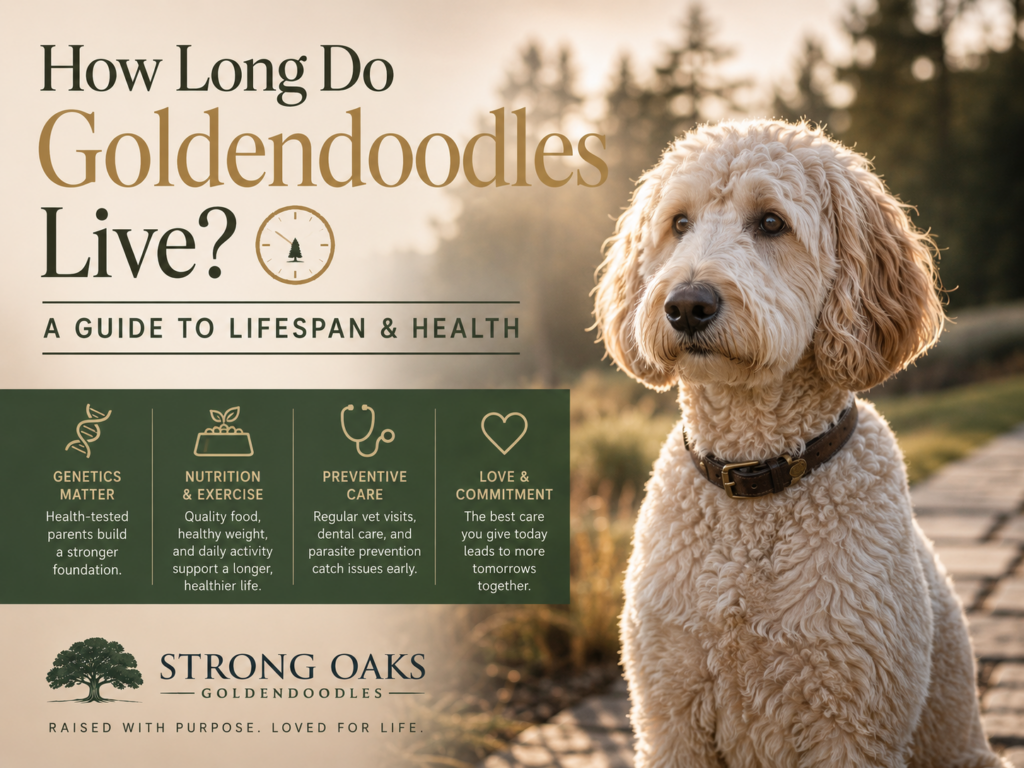
One of the most common questions families ask before committing to a dog is how long they’ll have them. It’s a fair question — a dog isn’t just a purchase, it’s a relationship, and knowing what to expect helps families plan and prepare.
Here’s an honest look at Goldendoodle lifespan, what affects it, and what you can do to give your dog the longest, healthiest life possible.
Typical Goldendoodle Lifespan
Goldendoodles generally live between 10 and 15 years. Where a specific dog lands in that range depends on several factors — genetics, size, diet, exercise, veterinary care, and the health of the parent dogs they came from.
Standard Goldendoodles — the size we breed exclusively at Strong Oaks — tend to fall toward the middle of that range, typically 10 to 13 years. Larger dogs generally have shorter lifespans than smaller ones, which is true across breeds. This doesn’t mean a Standard Goldendoodle won’t reach 14 or 15 — many do — but it’s the honest expectation for a dog in the 50 to 80 pound range.
What Affects Lifespan
Genetics is the single biggest factor. A puppy from health-tested parents with clean genetic profiles is starting life with a significant advantage over one from untested parents who may be carrying heritable disease. This is why DNA health testing of parent dogs isn’t just a marketing point — it’s a genuine investment in the longevity of every puppy produced.
At Strong Oaks, our parent dogs are Embark DNA tested before breeding — screening for over 250 genetic health conditions that can affect lifespan and quality of life. You can learn more about why this matters on our Health Guarantee page and our post on why health-tested parents matter.
Size plays a role too. As mentioned, larger dogs age faster than smaller ones. This is well-documented across species and isn’t specific to Goldendoodles. It’s one of the tradeoffs of choosing a Standard over a Mini — you get more dog in every sense, including the fact that the years may be slightly fewer.
Diet and exercise have a meaningful impact on both lifespan and quality of life. A Goldendoodle fed a high-quality diet, kept at a healthy weight, and given consistent daily exercise will almost always outlive and outperform a dog that isn’t. Obesity in particular shortens lifespan in dogs just as it does in humans — it puts stress on joints, heart, and organs.
Veterinary care matters more than most people account for when they’re budgeting for a dog. Annual wellness visits catch problems early. Dental disease — one of the most common and preventable health issues in dogs — affects heart, kidney, and liver function when left untreated. Heartworm prevention, kept current year-round in North Carolina, protects against a condition that can shorten life significantly if contracted.
Common Health Concerns in Goldendoodles
Like any breed, Goldendoodles can be predisposed to certain conditions. Understanding them helps you watch for early signs and address problems before they become serious.
Hip and elbow dysplasia is the most commonly discussed orthopedic issue in larger dogs. Our 5-year health guarantee specifically covers crippling hip and elbow dysplasia because we take it seriously. DNA testing screens for genetic markers associated with these conditions, and we choose our pairings carefully with this in mind.
Progressive retinal atrophy (PRA) is a heritable eye condition that can lead to blindness. Embark DNA testing screens for known PRA variants, and breeding from clear parents dramatically reduces the risk of affected offspring.
Subvalvular aortic stenosis (SAS) is a heart condition seen in some Golden Retriever lines. It’s one of the reasons health testing matters — not just DNA testing, but choosing parent dogs from lines with clean cardiac histories.
Bloat (gastric dilatation-volvulus) is a risk in larger, deep-chested dogs of any breed. Feeding from a raised bowl, avoiding exercise immediately after meals, and knowing the signs of bloat are practical steps every large dog owner should take.
Ear infections are common in Goldendoodles due to their floppy ears and the hair that grows inside the ear canal. They’re not life-threatening but they are quality-of-life issues that, left untreated chronically, can cause permanent damage. Weekly ear checks and regular grooming help prevent them. Our Goldendoodle Grooming guide covers ear care in detail.
The Role of the Breeder
The choices made before a puppy is born — which dogs to breed, what health testing to run, how the puppy is raised in those first critical weeks — set the trajectory for that dog’s health and longevity. This is why the breeder you choose matters so much, and why price shopping without considering those factors is a false economy.
Our guide on what to look for in a Goldendoodle breeder walks through exactly what questions to ask. And if you’re wondering what well-bred actually costs, our breakdown of Goldendoodle pricing puts that in context.
Making the Most of Every Year
10 to 15 years goes faster than anyone tells you. Families who are intentional about their dog’s health from day one — quality food, consistent exercise, regular vet care, dental hygiene, maintaining a healthy weight — consistently report healthier, happier dogs well into their senior years.
The bond that develops between a well-bred Goldendoodle and a family over a decade or more is one of the most rewarding things we get to witness as breeders. Every puppy we place is one we hope to hear about for years — at one year, at five, at ten.
If you’re ready to start that journey, our adoption application is the first step. Or call us at 828-408-3108 — we’re always happy to talk through what to expect from a Strong Oaks Goldendoodle from day one to year fifteen.
Ready to Find Your Perfect Goldendoodle?
Family-raised in the Blue Ridge Mountains of NC. Health-tested parents, 5-year guarantee, and 30+ years of experience.