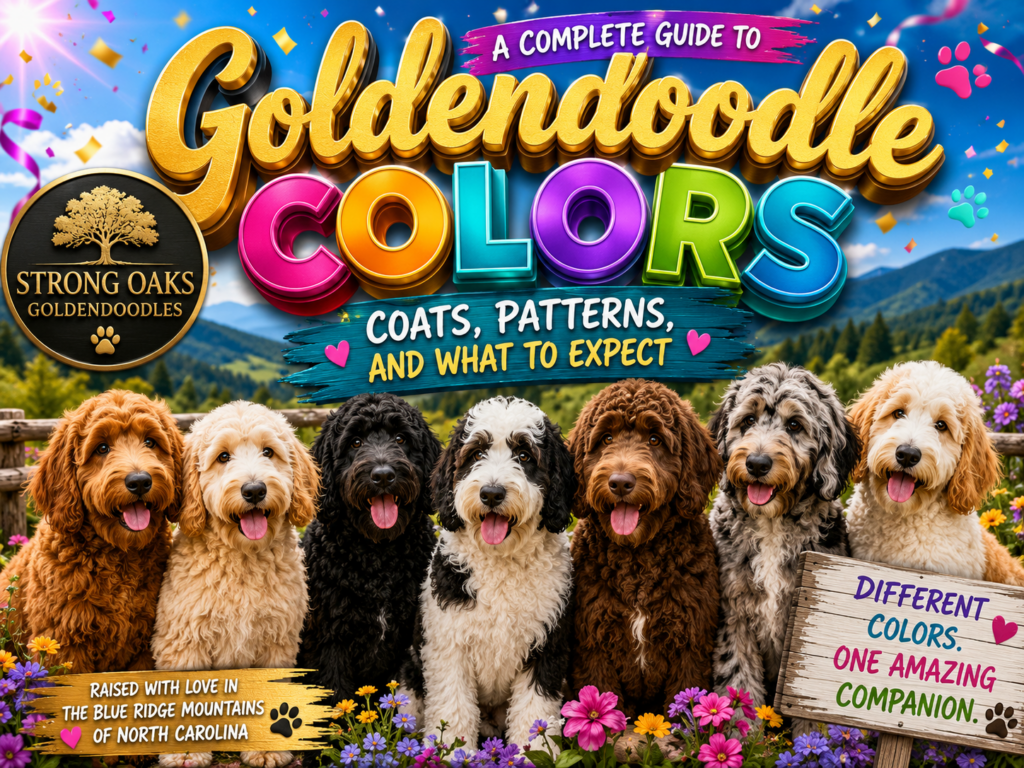
One of the most enjoyable parts of researching Goldendoodles is discovering just how many colors and patterns they come in. From deep mahogany red to soft cream, from solid coats to striking parti patterns, Goldendoodles offer more variety than almost any other family dog. But color is also one of the most misunderstood parts of the breed — and if you’re choosing a puppy, it helps to understand what you’re actually looking at.
After more than thirty years raising dogs here in the Blue Ridge Mountains of North Carolina, we’ve seen just about every color a Goldendoodle can be. Here’s an honest breakdown of the colors and patterns you’ll encounter, how they develop, and what actually matters when you’re choosing a puppy.
Where Goldendoodle Colors Come From
A Goldendoodle’s color is inherited from both sides of its family tree — the Golden Retriever and the Standard Poodle. Golden Retrievers contribute the warm golden-to-red range the breed is named for, while Standard Poodles bring a much wider palette: black, cream, apricot, silver, brown, and the genes behind patterns like parti and phantom.
Because every Goldendoodle is at least half Poodle — and our F1B and F1BB puppies carry even more Poodle influence — the Poodle side is where most of the color and pattern variety comes from. That’s part of why understanding a puppy’s generation matters, and if you’re still sorting out what F1, F1B, and F1BB mean, our guide on F1 vs F1B vs F1BB Goldendoodles walks through it in plain language.
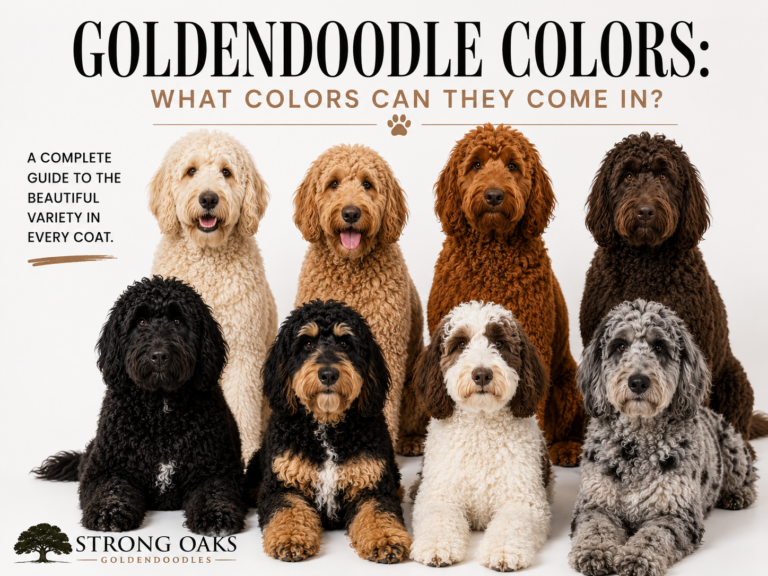
The Most Common Solid Goldendoodle Colors
Golden and Apricot. This is the classic teddy-bear look most people picture when they think of a Goldendoodle — warm, golden, and soft. Apricot is a lighter, more pastel version of golden, and the two often shift into each other as a puppy matures.
Red. A deeper, richer version of golden that ranges from copper to true mahogany. Red is one of the most sought-after Goldendoodle colors, and it tends to soften somewhat as the dog ages.
Cream and White. Pale, light coats ranging from soft ivory to nearly white. These are elegant, popular, and tend to show dirt a little more — which just means a bit more attention to coat upkeep between grooms.
Black. A solid, glossy black coat that comes almost entirely from the Poodle side. Black Goldendoodles are striking and, in our experience, underrated — they hold their color beautifully.
Chocolate and Brown. Ranging from milk-chocolate to deep brown, often with lighter eyes and liver-colored noses. Chocolate can fade or “silver” somewhat with age depending on genetics. Worth knowing: like parti, true chocolate isn’t found in Golden Retrievers, so a chocolate Goldendoodle almost always requires Poodle genetics from a backcross — another reason generation matters when you’re after a specific color.
Goldendoodle Patterns (Not Just Solid Colors)
Beyond solid coats, Goldendoodles can carry patterns that make each puppy genuinely one of a kind:
Parti. A parti coat is at least 50% white with patches of a second color, and it’s one of the most eye-catching patterns a Goldendoodle can have. Here’s something most families don’t realize: you cannot get a parti F1 Goldendoodle. Parti is a recessive trait, which means a puppy has to inherit the gene from both parents to actually show the pattern — and Golden Retrievers don’t carry it at all. That’s why a first-generation Goldendoodle (one purebred Golden Retriever, one purebred Poodle) can never be parti. It’s simply not genetically possible.
The earliest a parti coat can appear is the F1B generation, when a parti-carrier Goldendoodle is bred back to a parti Poodle so the puppies can inherit two copies of the gene. This is one more reason a breeder’s understanding of coat genetics matters, and why our F1B and F1BB program opens up color and pattern possibilities that first-generation-only breeders simply can’t produce. If a breeder is advertising a “parti F1,” that’s a genetic red flag worth asking about.
Phantom. Think of the classic “Doberman” pattern — a solid base color with defined markings above the eyes, on the muzzle, chest, and legs. Like parti, phantom is recessive and requires the right genetics from both parents, so it’s uncommon in first-generation dogs and shows up more reliably in backcross and multigen litters. Phantoms are among the most dramatic-looking Goldendoodles.
Abstract (or Mismark). A mostly solid coat with small splashes of white, often on the chest, paws, or face. Abstract markings are often a sign that a dog carries a single copy of the parti gene without being fully parti. Very common and very charming.
Sable and Merle. Sable coats have hairs tipped in a darker shade that can shift as the dog matures. Merle is a mottled, marbled pattern. A quick honesty note here: merle carries genuine health risks when two merle-carrying dogs are bred together, which is one of many reasons we test our parent dogs through Embark before any breeding decision. You can read more about how careful breeding shapes a healthy puppy in our post on what makes a Goldendoodle.
Why Goldendoodle Color Changes as They Grow
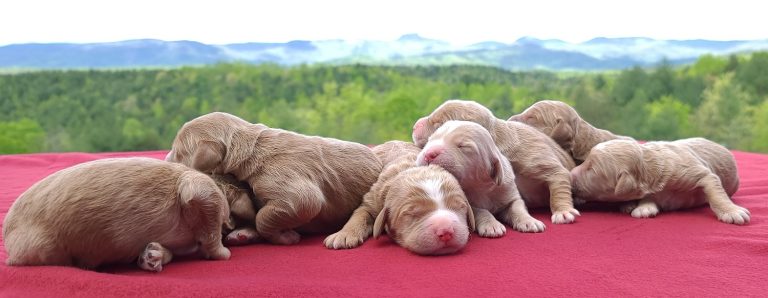
Here’s something that surprises a lot of first-time families: the color of the puppy you pick up at eight weeks is often not the color of the adult dog you’ll have a year later. Many Goldendoodles — especially reds, apricots, and chocolates — “clear” or lighten as they mature. A rich red puppy may soften to a strawberry blond; a dark chocolate may develop silver tones.
This is completely normal and comes from the Poodle side of the family, where coat-clearing is common. It’s one reason we gently encourage families not to choose a puppy on color alone.
Does Color Affect Temperament or Health?
For solid colors and most patterns — no. A black Goldendoodle is no calmer than a red one, and a cream puppy is no more or less healthy than an apricot. Coat color is largely cosmetic.
The one real exception is merle, as mentioned above, which is why responsible testing and breeding decisions matter far more than chasing a particular look. Temperament, structure, and health come from thoughtful breeding and early development — not from color. If you’re curious how we raise confident puppies from day one, our post on ENS and early socialization explains our approach.
Choosing a Puppy: Why We Say Color Comes Last
We understand the appeal of a specific color — we really do. But after three decades, our honest advice is to prioritize temperament and fit over coat color every time. The right puppy for your family is the one whose personality matches your household, not the one whose color matches your throw pillows.
Many of our families come in set on one color and go home with a completely different puppy they fell in love with. That’s usually a sign the match was right.
A practical note on lighter coats: cream, white, and apricot Goldendoodles show dirt and staining a little more, so they benefit from consistent brushing and the occasional freshen-up between grooming appointments. If you want to see the specific brushes and coat-care products we actually use on our own dogs, we keep an honest, short list on our recommended products page.
The Bottom Line
Goldendoodles come in a beautiful range of colors and patterns — golden, red, cream, black, chocolate, parti, phantom, and more — and much of that variety comes from their Standard Poodle heritage. Some of the most striking patterns, like parti, aren’t even genetically possible in a first-generation dog, which is one more reason the generation and the breeder’s knowledge behind a litter really matter. Colors also often shift as puppies mature, so the smartest approach is to focus on health, temperament, and the guidance of a breeder who knows their puppies well.
If you’d like to talk through what colors and patterns we typically see in our litters, or you’re ready to find your match, we’d love to hear from you. You can start with our adoption application — it only takes a few minutes, and it’s the first step toward bringing home your Goldendoodle.
Ready to Find Your Perfect Goldendoodle?
Family-raised in the Blue Ridge Mountains of NC. Health-tested parents, 5-year guarantee, and 30+ years of experience.