Size is one of the first things families want to know when they’re considering a Goldendoodle. And it’s a fair question — a 25-pound dog and a 75-pound dog require very different things from a household, a car, a yard, and a budget.
Here’s what you can actually expect from a Standard Goldendoodle, and why “standard” means something specific.
What Is a Standard Goldendoodle?
Goldendoodles come in several size categories depending on which size Poodle was used in the breeding — Toy, Miniature, or Standard. A Standard Goldendoodle uses a Standard Poodle parent, which is the largest of the three Poodle sizes. Combined with a Golden Retriever — already a medium-to-large breed — the result is a substantial, athletic dog.
At Strong Oaks we breed Standard Goldendoodles exclusively. We made that choice deliberately, and we’ve never second-guessed it. Standard Goldendoodles have a solidity and presence that we believe makes them better suited to active family life than their smaller counterparts.
How Much Do Standard Goldendoodles Weigh?
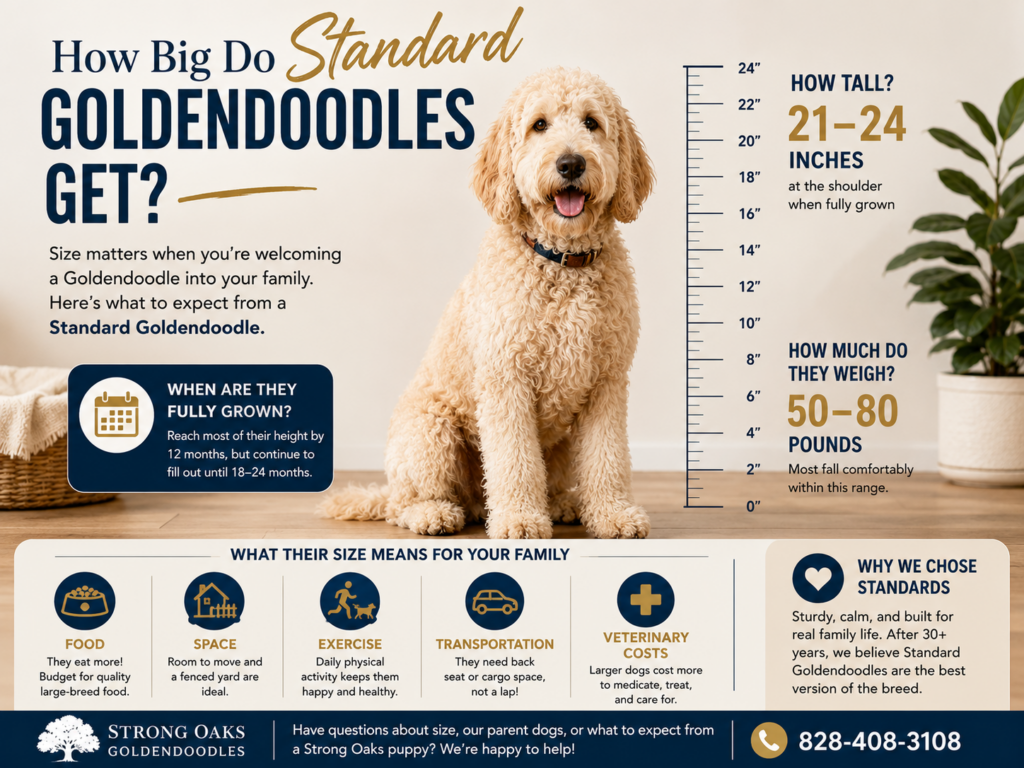
A fully grown Standard Goldendoodle typically weighs between 50 and 80 pounds. Most of our dogs land comfortably in that range, with males tending toward the higher end and females toward the lower end.
That said, genetics aren’t perfectly predictable. The Golden Retriever parent tends to run 55 to 75 pounds and the Standard Poodle 40 to 70 pounds — so the offspring can land anywhere across a fairly wide range. A puppy from two larger parents is likely to be a larger adult dog. We’re happy to share information about our parent dogs’ sizes with any family on our waitlist.
How Tall Do They Get?
Standard Goldendoodles typically stand between 21 and 24 inches at the shoulder when fully grown. That puts them firmly in the large dog category by most breed classification standards. They’re not giant dogs — they won’t dwarf your furniture or require a small car to transport — but they are real, substantial animals that need real space.
When Are They Fully Grown?
Standard Goldendoodles reach most of their height by around 12 months but continue to fill out in muscle and body weight until 18 to 24 months. This is important to keep in mind for exercise — even a dog that looks nearly full-grown at a year old still has developing joints and shouldn’t be pushed into high-impact activities like long runs or repetitive jumping until closer to two years of age.
Does Size Affect Temperament?
Not directly — but size does interact with temperament in practical ways. A 70-pound dog that jumps up in greeting is a much more significant event than a 20-pound dog doing the same thing. Teaching a Standard Goldendoodle not to jump is important early, particularly in households with small children or elderly family members.
On the positive side, Standard Goldendoodles have a physical confidence and calm that smaller dogs sometimes lack. They’re less reactive, less skittish, and more naturally settled in busy environments. The size that requires more training up front pays dividends in a calmer, more even-tempered adult dog.
What Do They Need Because of Their Size?
Food — a Standard Goldendoodle eats significantly more than a Mini. Budget for a quality large-breed food and expect to go through it at a meaningful rate.
Space — they don’t need a mansion, but they do need room to move. A home with a fenced yard is ideal. Apartment living is possible with very committed daily exercise, but it’s not the environment these dogs thrive in most naturally.
Exercise — daily physical activity is important for a dog this size. A Standard Goldendoodle that doesn’t get adequate exercise will find other outlets for their energy, usually in ways you’d rather they didn’t.
Transportation — a Standard Goldendoodle needs a back seat or cargo area, not a lap. If your vehicle situation is tight, it’s worth thinking through before you commit to a dog this size.
Veterinary costs — larger dogs generally cost more to medicate, treat, and care for than smaller ones. Anesthesia, preventatives, and treatments are often dosed by weight. It’s not prohibitive, but it’s worth factoring into your planning.
Why We Chose Standards
We get asked this regularly, and the answer is simple: we believe Standard Goldendoodles are the best version of the breed for family life. They’re sturdy enough to handle the energy of children, calm enough to settle into a household routine, and substantial enough to be true companions rather than accessories. The families we’ve placed Standard Goldendoodles with for over 30 years consistently tell us the same thing — they can’t imagine having gone smaller.
If you have questions about size, our parent dogs, or what to expect from a Strong Oaks puppy specifically, give us a call at 828-408-3108.
Ready to Find Your Perfect Goldendoodle?
Family-raised in the Blue Ridge Mountains of NC. Health-tested parents, 5-year guarantee, and 30+ years of experience.